
International anti-corruption summit organized by the Integrity Authority of Hungary
Cikk publikálásának ideje:
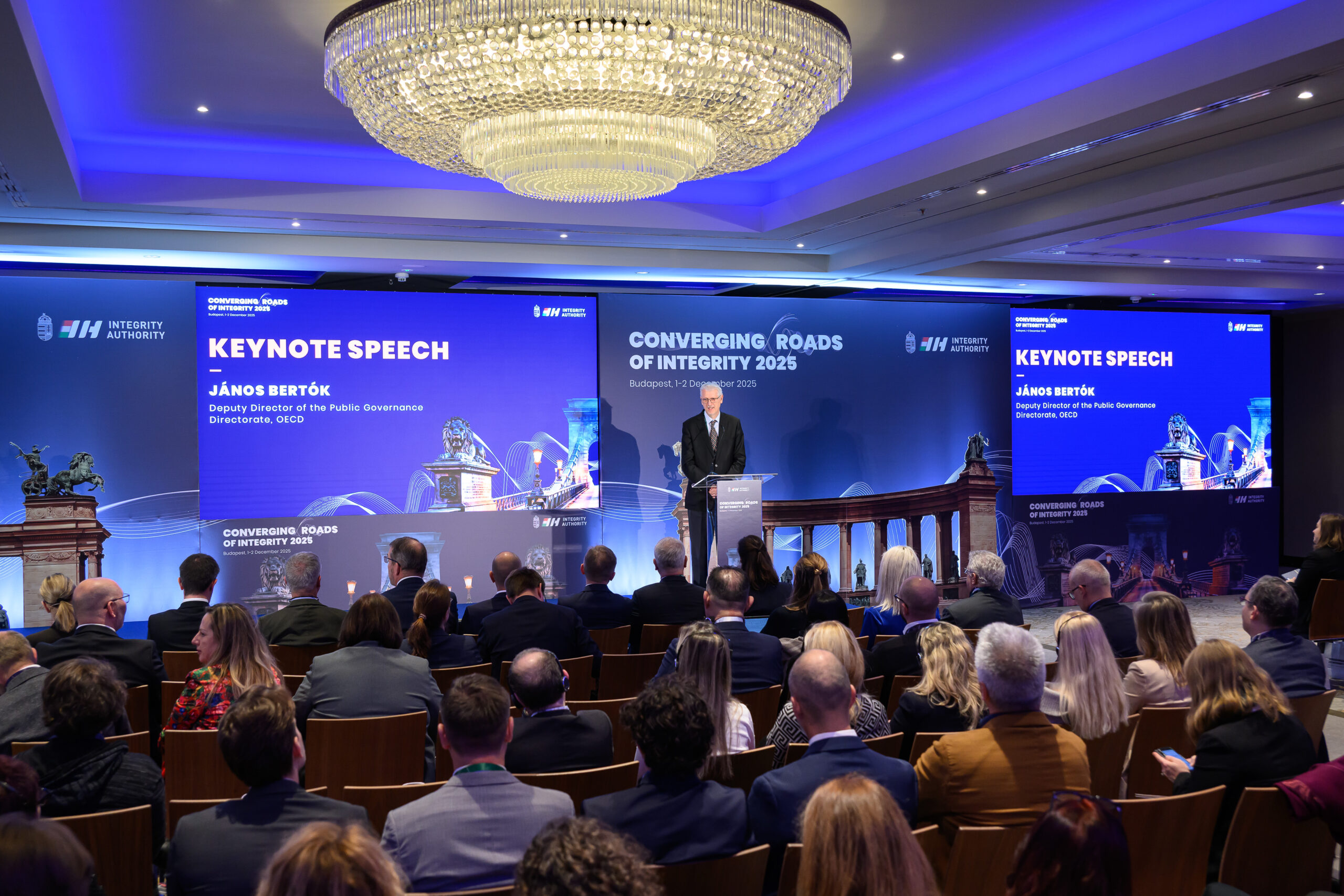
Strengthening an economic culture built on the responsible use of public funds and promoting the efficient and transparent use of domestic and European Union funds were the focus of the year’s most important anti-corruption event in Hungary, held on 1–2 December in Budapest. The conference was organised by the Integrity Authority and attended by professionals from both Hungary and abroad.
The application of AI-based risk analysis to boost transparency in public procurement, the role of younger generations in strengthening a culture of integrity, as well as communication and educational aspects in anti-corruption awareness-raising, were among the topics discussed at Converging Roads of Integrity 2025: Aligning efforts for integrity in public spending, an international conference where leading experts from Hungary, the European Union and beyond shared their experiences about best practices in the use of public funds, the application of artificial intelligence, and integrity-based public administration. Speakers included representatives from the OECD, OLAF, and other international organisations. The conference aimed to facilitate the exchange of international best practices and to encourage long-term cooperation to promote the ethical, lawful and efficient use of public funds.
The opening speeches of the international anti-corruption conference were delivered by Ferenc Pál Biró, President of the Integrity Authority, and Piotr Serafin, European Commissioner for Budget, Anti-Fraud and Public Administration.
“Fighting corruption in the EU is also about preserving mutual trust. We ask the governments of 27 Member States to contribute part of their national budgets to a common European pot. In reality, we ask millions of Europeans to contribute part of their income to finance our common priorities”, said Piotr Serafin during his opening speech. “We do this because we believe that every euro spent in one Member State brings benefits to all, especially through the spillover effects of the Single Market. But if our citizens see that their money is being stolen, they will lose trust in the EU – and the damage will be irreparable.”

The Commissioner believes that the Integrity Authority “strengthens trust in institutions, trust in democracy, and creates value for society as a whole”.
In his speech, Ferenc Pál Biró, President of the Integrity Authority, highlighted that there is no single guaranteed solution to countering corruption, but approaches converge on the principle that the organisation responsible for this task must be an independent, socially embedded institution with a broad mandate. “I wish for this conference to become a true meeting point – a hub for ideas, experiences and best practices.
Our goal is to move closer to a future together where integrity is not an expectation but an everyday reality”, said Ferenc Biró in his closing remarks.
In the focus: transparency in EU funds and their domestic utilisation
A central message of this professional forum was that the transparent and efficient use of public funds is not merely a policy issue but a matter of national interest, contributing to increased economic competitiveness, incentivising investment, and improving the quality of public services.
An important objective of the Integrity Authority is to strengthen cooperation between domestic and international oversight and control organisations and to contribute to the lawful and efficient use European Union funds. The expert discussions and presentations covered topics such as international norms, transparency, the presentation, analysis and improvement of cross-border information flows and modern law-enforcement methods, the identification of new technologies, as well as preventive measures and educational efforts that support the protection of public funds. The plenary section’s keynote speeches were delivered by János Bertók, Deputy Director for Public Governance at the OECD, and Vasil Kirov, Director for Expenditure Investigations and Operations at OLAF.
Asset recovery: on the brink of a new strategy
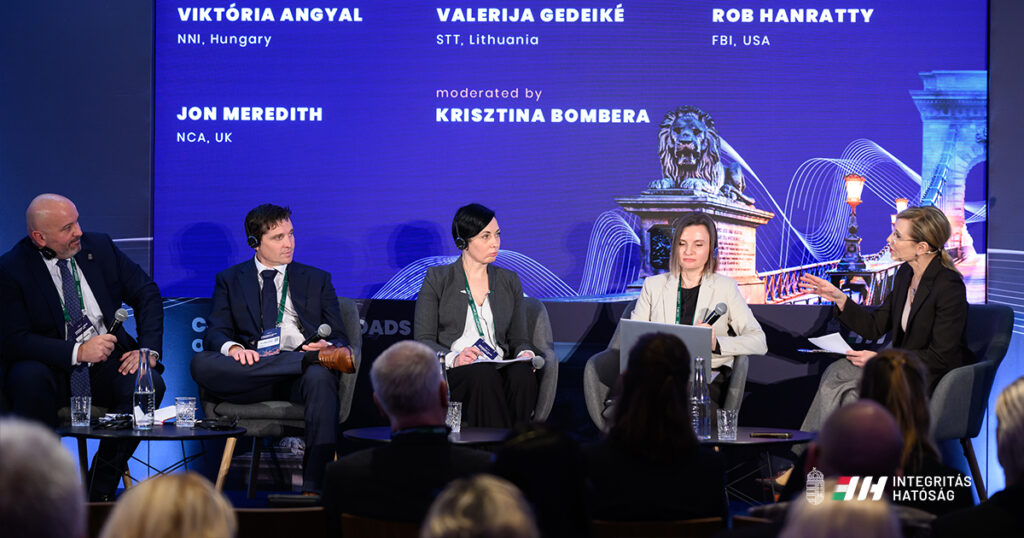
One of the sections addressed challenges in asset tracing and recovery in an international context. Although this area was just one of the many topics discussed at the conference, its relevance is underscored by the fact that the European Union expects Member States to develop new asset recovery strategies by 2027. Hungarian and international experts participating in the panel discussions – including Rob Hanratty (FBI), Jon Meredith (NCA), and Viktória Angyal (NNI) – drew upon the latest experiences to explore what sort of opportunities and challenges cross-border co-operation and modern technologies harbour for tracing assets obtained through criminal offences. In the afternoon, a challenging discussion took place about the possible paths of cultural change in the economy, with the participation of Martin Lee (Hong Kong ICAC), Nicola Allocca (Business at OECD), Pawan Kumar Sinha (International Anti-corruption Academy, IACA), as well as Márton Suppan (founder and CEO of Peak), accompanied by Ferenc Biró.
The day concluded with presentations by the Anti-Corruption Task Force (Dr. Szilvia Várady) and the Integrity Academy (Dr. Petra Burai).
Innovation in the service of anti-corruption
On the second day, professional programmes were conducted in three parallel sections, focusing respectively on the possibilities offered by AI, the strengthening of integrity in the public procurement ecosystem, and the engagement of younger generations. The Integrity Authority also presented its own AI-based risk analysis system, developed with the involvement of the European Commission and the OECD.

Also among the conference topics was the responsible and efficient use of public funds in European Union and domestic public procurement – a session that attracted a packed audience. Following the opening presentation by Réka Kenessey, Professional Director of the Integrity Authority, panel discussions took place with the participation of the Public Procurement Authority, the Directorate General for Audit of European Funds (EUTAF), the National Development Centre, the OECD, and Transparency International. This was the topic of a different section, including the involvement of young people in anti-corruption efforts. The results of the KORR-KÉP study, the Integrity Academy’s representative youth research, were also presented, along with the preparations for educational initiatives focusing on the 15–29 age group.
Summaries of conference discussions and presentations will be published soon in separate blog posts.