
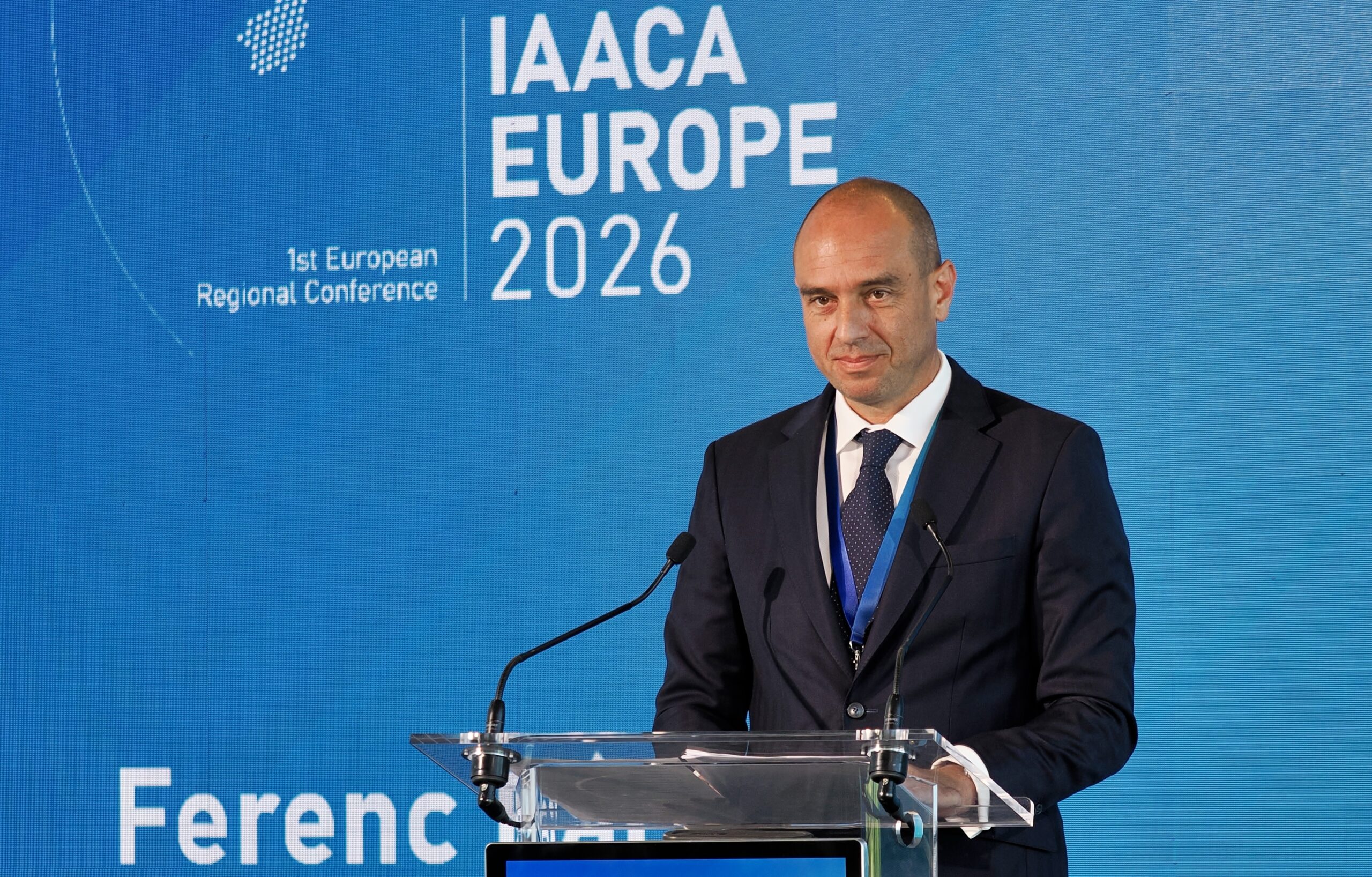
President Ferenc Biró’s opening speech at the IAACA Europe 2026 in Budapest
Cikk publikálásának ideje:
Dear Presidents, Excellencies, Distinguished Guests and Colleagues,
It is a great honour to welcome you to Budapest and to open the IAACA Europe 2026 Conference.
We meet here as practitioners, policy‑makers and experts who share a very concrete responsibility: to ensure that the fight against corruption is not a matter of declarations, but of effective daily work across borders.
Let me begin with a simple observation.
Just as privately accumulated wealth derived corruptly from public funds does not respect national borders, efforts to trace it cannot stop at the border either. Today, anti‑corruption authorities from every continent are sitting together in one room. That fact alone sends a message: we are building a cross‑border line of defence behind which corruption and corruptly acquired assets can no longer rely on a safe hiding place.
The work of the institutions represented here can only be credible if we are – and are seen to be – independent. Anti‑corruption bodies, audit institutions and prosecutors must be able to investigate and to decide without political interference, guided by law and evidence alone.
When citizens see that cases involving sensitive interests are handled with the same professionalism as any other, their trust in democratic institutions grows. When they see hesitation, selective enforcement or pressure from above, that trust erodes quickly – and is very hard to rebuild. Safeguarding institutional independence is therefore not a technical detail; it is the foundation on which all our other efforts rest.
In my own country, Hungary, we have had to confront this reality quite directly. There have been years
- in which the rule of law was bent;
- in which a narrow circle close to political power could extract rents from public resources;
- in which checks and balances were not merely weak, but were weakened on purpose.
That is is the cumulative record of auditors, courts, European institutions – and of citizens who watched their taxes diverted from public purposes.
The Integrity Authority exists because that model hit a wall – financially, politically and institutionally. If you build a system around insiders, opacity and informal influence, three things happen sooner or later:
- partners lose patience,
- markets demand a premium,
- and your own public turns on you.
Our task now is to make sure that this moment of impact becomes a turning point, not just a shock – a step away from what many have perceived as a “country without consequences”, and towards a country of consequences, in which corruption and corruptly acquired wealth truly have nowhere to hide.
A second foundation of effective anti‑corruption work is access to information.
None of us can follow the money if the trail is fragmented, delayed or hidden behind formal excuses. Timely, comprehensive access to
- contracts,
- beneficial‑ownership data,
- banking information
- and digital records
is essential if we want to detect complex schemes and to recover stolen assets.
Asset recovery is not only about numbers in a report. It is a visible message to society that corruption does not pay, and that public funds can be brought back to the communities and services they were meant to support.
The new EU Anti‑Corruption Directive will raise the bar further. It will require Member States to modernise legal frameworks, to criminalise certain behaviours more consistently, and to strengthen prevention, investigation and sanctioning.
For national authorities, that means extra tasks and higher expectations:
- better protection of whistle‑blowers,
- more systematic risk assessments,
- closer cooperation with European bodies,
- and a stronger focus on cross‑border cases.
These are demanding changes, especially where institutions are still catching up with past deficits. But they are also an opportunity to align our practices, to close loopholes, and to offer a more coherent response to corruption that – like illicit assets – does not stop at national borders.
For Hungary, this alignment is not an abstract legal exercise.
It is a test of whether we can turn the “wall” we have hit into a support for something more stable:
- more transparent procedures,
- more predictable enforcement,
- and a system that is less hospitable to corrupt practices.
The Integrity Authority’s role is to help build trust, to prevent and to detect, to highlight systemic risks, and to strengthen those institutions – prosecutors, courts, audit offices – that are responsible for enforcing legal accountability. We do not replace them; we support them by making risks and patterns visible, and by helping to ensure that serious cases do not disappear into a grey zone.
Today’s conference is meant to support exactly this type of evolution, in Hungary and beyond. Cooperation cannot remain a theoretical slogan in our strategies and communiqués.
It has to take the form of very practical knowledge‑sharing between authorities:
- how we secure access to data in sensitive sectors,
- how we design asset‑recovery mechanisms that actually work in practice,
- how we protect our staff from pressure,
- and how we implement the new Directive in different legal systems while maintaining a common level of ambition.
Over the coming days, I would encourage you to speak frankly – not only about best practices, but also about the difficulties you face: legal gaps, institutional resistance, resource constraints.
This room is one of the few places where we can admit that past approaches have sometimes failed, and where we can learn from that failure without stigma. The personal and institutional relationships you build here can make the difference, years from now, between a dead end and a joint investigation; between an untouchable asset and one that is finally returned to the public.
I hope that this conference will bring us closer to a world in which corruption and corruptly acquired wealth truly have nowhere to hide – in Hungary, in Europe and in every other part of the world.
Thank you for your presence, for your commitment, and for the work you do every day.