

What do Hungarians think of corruption?
Cikk publikálásának ideje:
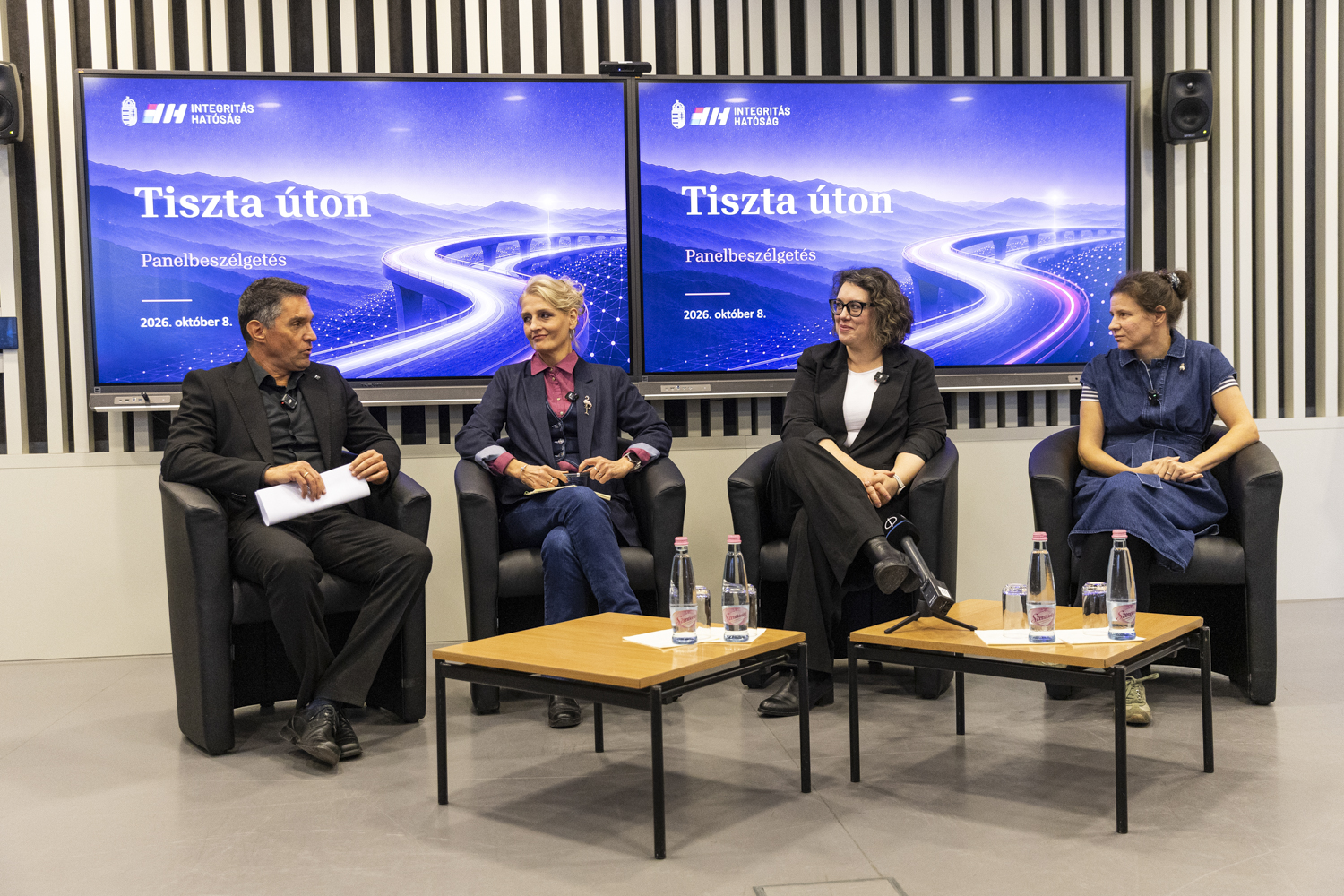
After inflation and public healthcare, corruption ranks as the third most pressing social issue in Hungary, according to findings from a survey of the Hungarian public conducted as part of the Integrity Authority’s comprehensive nationwide research programme, On the Right Path (original title in Hungarian: Tiszta úton). This is the first representative survey in Hungary examining public experiences and attitudes regarding corruption and integrity. Repeated at regular intervals, the data collection makes it possible to track changes in public attitudes over time. The study was presented as part of a press conference.
(The opening picture shows the panelists at the press conference: Zoltán F. Baka, journalist, moderator; Dr Andrea Szabó, research professor at ELTE Centre for Social Sciences Institute for Political Science; Dr Petra Burai, head of education of the Integrity Authority; and Dr Orsolya Vincze, legal expert at K-Monitor)
The Study in Numbers: Key Findings
- Among the population, 41.6% consider corruption one of the three most serious social problems.
- Nearly three-quarters – more specifically 73.7% – of the population believe that corruption is considerably or extremely widespread in Hungary.
- Almost three quarters (73.6%) of the population said that they considered corruption unacceptable.
- Only one in four Hungarians (26.8%) would take action upon encountering suspected cases of corruption.
Corruption at the Forefront of the Social Problem Landscape
As the Integrity Authority’s first nationwide representative attitude research programme, On the Right Path covers areas such as corruption perception, specific corruption experiences, institutional trust, people’s willingness to report, and the efficiency of the use of European Union funds. Based on the findings, just over two-fifths (41.6%) of Hungary’s adult population consider corruption one of the three most pressing issues, indicating systemic societal concerns.
According to 73.7% of Hungarians, corruption is either considerably widespread or extremely widespread in Hungary, a proportion that is considerably higher than the figure reported by Eurobarometer[1] in its comparison across EU member states. Almost half of the respondents (45.7%) believe that corruption increased considerably over the period between 2020 and 2025, while 20.9% reported a slight increase. Only 5.7% reported some reduction.
“There is a tangible anti-corruption value system in Hungarian society, and the rejection of corruption is undoubtedly an opinion shared by the majority. The data also show that people perceive those around them as more corrupt than they are themselves: they tend to view themselves in a more favourable light while holding more negative views of others. Meanwhile, people have relatively little concrete personal experience of corruption: only 7% of respondents reported having personally encountered cases of misconduct involving corruption, suggesting that corruption primarily occurs at higher levels of decision-making, far removed from the everyday lives of ordinary citizens, who tend to experience its effects rather than encounter it directly”, said Dr Petra Burai, head of education at the Integrity Authority and expert reviewer of the study.

Opposed Majority, Permissive Minority
Nearly three quarters (73.6%) of respondents said that they considered corruption unacceptable. Nevertheless, just over a quarter of respondents (26.4%) consider corruption completely or rather acceptable in public institutions if it allows them to gain a personal advantage. In a regional breakdown, the rate of respondents considering corruption “completely acceptable” was highest in Budapest, meaning that those living in the capital are more “tolerant” of corruption.
More than 90% of Hungarians reject offering cash in exchange for some form of advantage, while only 30% consider offering gifts unacceptable and 34% consider doing favours unacceptable. The largest share of respondents consider “rather honest” behaviour to be the key to success in business.
Seven in Ten People Do Not Know Who to Turn to
Two-thirds of Hungarians (69.2%) do not know a single institution where they could report a suspected case of corruption, a result that falls short of the EU average (52.6%) and have a direct impact on people’s willingness to report: those aware of reporting channels are nearly four times more likely to report cases of abuse than those unaware of such platforms. Among respondents able to name an institution that takes action against corruption, the Integrity Authority ranked among the three most frequently cited anti-corruption organisations.
Based on the data, only 26.8% of respondents would take action upon encountering a suspected case of corruption. This widespread passivity is due to four main reasons:
- fear of retaliation;
- difficulties in producing evidence;
- procedural uncertainty (people do not know what to do);
- and a deeply-rooted conviction that taking action would not have any meaningful impact regardless.
Among respondents, 73.6% believe that public institutions are either “completely unable” or “rather unable” to protect the population from the adverse effects of corruption. The connection is clear: those who trust the institutions are significantly more likely to report cases of abuse.
EU funds: Things Look Better Locally
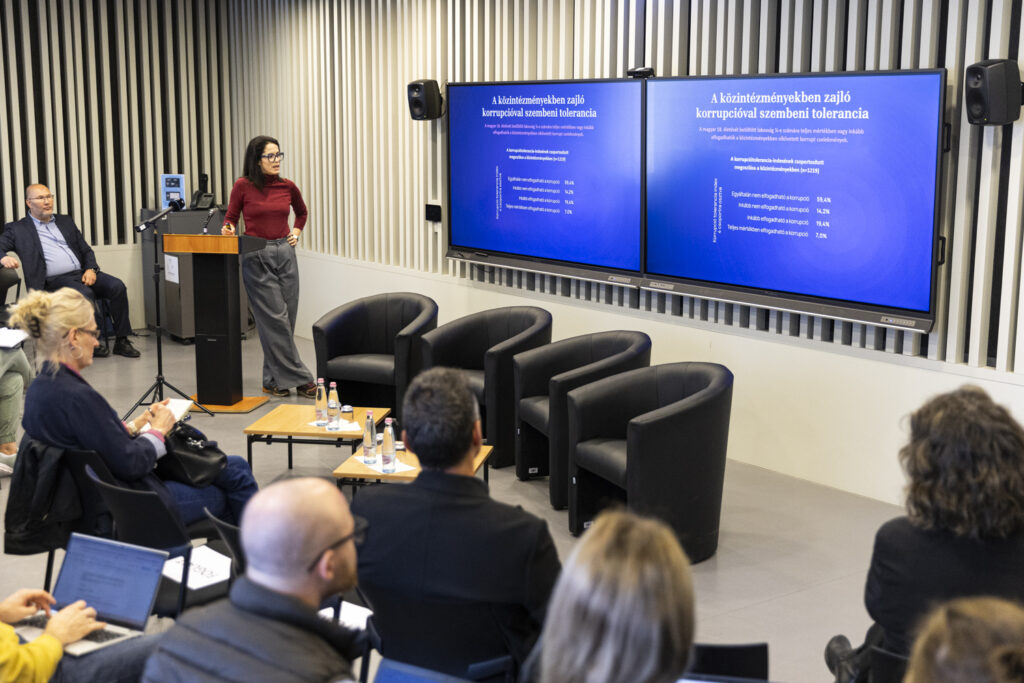
A total of 65.4% of Hungarians consider corruption to be widespread in the domestic use of European Union funds, while only 43.8% consider it to be widespread within EU institutions. Respondents consider corruption in the use of European Union funds to be more prevalent at the national level than at the local level: a majority (64%) have positive views of the local use of funds, while perceptions of their use at the national level are considerably more sceptical (44%). This difference may be attributable to the fact that at the local level, people have more direct encounters not only with potential irregularities but also with the benefits of these funds. Furthermore, trust in local institutions may be higher, which may contribute to more positive perceptions of the effectiveness of the local use of funds.
Media Consumption and Corruption Perception
The study statistically confirmed a distinctively Hungarian relationship between media consumption and corruption perception: those who rely on public-service television as their primary source of information were significantly less likely to perceive corruption as widespread than those who rely on other sources of information. At the time of the data collection, before April’s parliamentary elections, public perceptions of the public-service media and pro-government news outlets were strongly interconnected, with the public essentially treating these two types of media as belonging to the same category. When it came to news about corruption, respondents placed the greatest trust in media outlets critical of the government at the time, although trust in the media as a whole was generally low.
About the Research
The On the Right Path research study was carried out between July and September 2025 using a nationally representative sample (n=1,254) and a (hybrid-multimode) questionnaire-based data collection method combining online and in-person interviews. By extending the study to include the entire population aged 18 and over, the data collection complements KORR-KÉP, the Integrity Authority’s research programme focusing on young people, presented last year. The result is the first research report in Hungary to make it possible to track changes in societal attitudes toward corruption and integrity over time through a series of subsequent data collections, as no regular, repeatable data collection on these topics had previously been conducted in Hungary. The research programme’s declared objectives include repeating the data collection at regular intervals, monitoring long-term trends, and providing continued support in evidence-based anti-corruption decision-making.
The summary of the study is available both in Hungarian and in English via the following links: Tiszta úton lakosság kutatás (Hungarian); On the Right Path population survey (English)
[1] Based on microdata from the Eurobarometer 548 survey.